
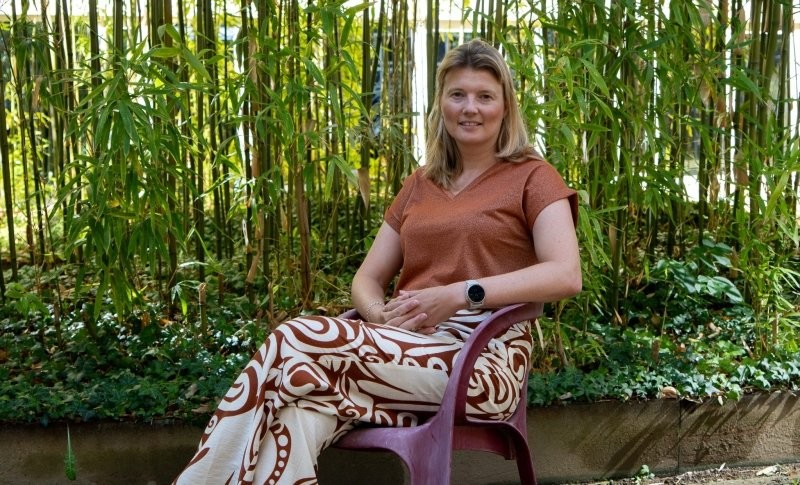
Matthijs Blankesteijn

Associate professor

Dr Matthijs Blankesteijn is associate professor of Pharmacology and Principal Investigator at CARIM. He obtained Master degrees in Biology and Chemistry from the Radboud University Nijmegen (1988), followed by a PhD degree from the same university in 1993. He then joined the Pharmacology department of Maastricht University as a post-doc, and after a postdoctoral training in Harvard Medical School in Boston in 1997-1998 (supervisor Prof. V. Dzau), he returned to the Department of Pharmacology as a staff member. For his research, he has received funding from ZonMw, NHS and FES, including a Vidi grant in 2003. He has published over 60 Wi-1 papers with an average Impact Factor of 6.3 and Hirsch-index of 28. He was elected as Board member of the Dutch Society of Pharmacology in 2015.

Department of Pharmacology & Toxicology
Universiteitssingel 50, 6229 ER Maastricht
PO Box 616, 6200 MD Maastricht

  • 2025
    • Pinckaers, N. E. T., Blankesteijn, W. M., Mircheva, A., Punt, A., Opperhuizen, A., van Schooten, F.-J., & Vrolijk, M. (2025). Quantitative in vitro-to-in vivo extrapolation of human adrenergic and trace amine-associated receptor 1 potencies of pre-workout supplement ingredients using physiologically based kinetic modelling-based reverse dosimetry. Archives of Toxicology, 99(5), 1999-2021. https://doi.org/10.1007/s00204-025-03992-7
    • Baker, M. B., Hazell, G., van Rijt, S., Blankesteijn, W. M., Welting, T., den Akker, G. V., & Bauer, J. (2025). Teaching Chemistry in the New Bachelor “Regenerative Medicine and Technology”. Croatica Chemica Acta, 98(2), 157-166. https://doi.org/10.5562/cca4185
    • Manukjan, N., Fulton, D., Ahmed, Z., Blankesteijn, W. M., & Foulquier, S. (2025). Vascular endothelial growth factor: a double-edged sword in the development of white matter lesions. Neural Regeneration Research, 20(1), 191-192. https://doi.org/10.4103/NRR.NRR-D-23-01843
  • 2024
    • Manukjan, N., Chau, S., Caiment, F., van Herwijnen, M., Smeets, H. J., Fulton, D., Ahmed, Z., Blankesteijn, W. M., & Foulquier, S. (2024). Wnt7a Decreases Brain Endothelial Barrier Function Via β-Catenin Activation. Molecular Neurobiology, 61(7), 4854-4867. https://doi.org/10.1007/s12035-023-03872-0
    • Pinckaers, N. E. T., Blankesteijn, W. M., Mircheva, A., Shi, X., Opperhuizen, A., van Schooten, F.-J., & Vrolijk, M. F. (2024). In Vitro Activation of Human Adrenergic Receptors and Trace Amine-Associated Receptor 1 by Phenethylamine Analogues Present in Food Supplements. Nutrients, 16(11), Article 1567. https://doi.org/10.3390/nu16111567
  • 2023
    • Manukjan, N., Majcher, D., Leenders, P., Caiment, F., van Herwijnen, M., Smeets, H. J. J., Suidgeest, E., van der Weerd, L., Vanmierlo, T., Jansen, J. F. A., Backes, W. H. H., van Oostenbrugge, R. J. J., Staals, J., Fulton, D., Ahmed, Z., Blankesteijn, W. M., & Foulquier, S. (2023). Hypoxic oligodendrocyte precursor cell-derived VEGFA is associated with blood-brain barrier impairment. Acta neuropathologica communications, 11(1), Article 128. https://doi.org/10.1186/s40478-023-01627-5
  • 2022
    • Pinckaers, N., Blankesteijn, M., Opperhuizen, A., Van Schooten, F. J., & Vrolijk, M. (2022). In vitro pharmacological characterization of phenethylamine and alkylamine analogues found in nutritional supplements at human adrenergic and trace amine-associated receptors. Toxicology Letters, 368, S280-S280. https://doi.org/10.1016/j.toxlet.2022.07.739
  • 2021
    • Gouweleeuw, L., Wajant, H., Maier, O., Eisel, U. L. M., Blankesteijn, W. M., & Schoemaker, R. G. (2021). Effects of selective TNFR1 inhibition or TNFR2 stimulation, compared to non-selective TNF inhibition, on (neuro)inflammation and behavior after myocardial infarction in male mice. Brain Behavior and Immunity, 93, 156-171. https://doi.org/10.1016/j.bbi.2021.01.001
    • Daskalopoulos, E. P., & Blankesteijn, W. M. (2021). Effect of Interventions in WNT Signaling on Healing of Cardiac Injury: A Systematic Review. Cells, 10(2), Article 207. https://doi.org/10.3390/cells10020207